

Most mid-market leaders treat workforce evolution as a soft-skills HR initiative. They're wrong. In reality, workforce transformation consulting is a high-stakes financial lever designed to re-engineer your enterprise system for maximum capital efficiency. You've likely felt the drag of inefficient legacy workflows and the frustration of consulting engagements that offer vague promises instead of hard metrics. It's time to move past the fear of AI-driven displacement and start viewing your talent through the lens of operational discipline.
We understand the pressure to deliver enterprise value in a market that demands rapid adaptation. This guide provides a roadmap to re-engineer your workforce for the AI era, ensuring your team is a catalyst for growth rather than a bottleneck. You'll learn how to achieve a clear ROI within 12 to 18 months by focusing on measurable outcomes like increased EBITDA and systemic integration. We'll unpack the precise framework required to build a future-proofed capability, turning technological disruption into a sustainable competitive advantage and a valuation multiplier.
Key Takeaways
- Re-engineer legacy workflows into AI-augmented systems that prioritize capital efficiency and long-term structural integrity.
- Leverage workforce transformation consulting to bridge the gap between high-level strategic vision and grounded, "in-the-trenches" operational execution.
- Implement 90-day "Lighthouse Projects" to secure rapid ROI and build the internal momentum necessary for enterprise-wide adoption.
- Transition from sentiment-based vanity metrics to the Capital Efficiency Index to track measurable impact on valuation and EBITDA.
- Integrate fractional leadership to ensure sustained operational discipline and courageous accountability throughout the transformation journey.
The Mid-Market Imperative for Workforce Transformation Consulting
Traditional consulting is fundamentally broken for the mid-market operator. Global firms sell high-level concepts that look great in a boardroom but crumble in the warehouse or the sales office. These "big box" consultants often lack the operational skin in the game required to move the needle on enterprise value. They sell slides. You need EBITDA. For the mid-market B2B leader, workforce transformation consulting must be about more than just vague progress; it must be about capital efficiency.
The 2026 reality is stark. If your business relies on labor-intensive legacy workflows, you're paying a hidden tax on your bottom line. We view the organization as an "Enterprise System" where strategy, AI, and people act as a single, integrated unit. Within the broader context of business transformation, workforce evolution has become the most significant valuation multiplier available to private equity portfolios and independent firms alike. Transformation is no longer a "nice to have" project. It's the baseline for survival.
Why 'Soft' HR Transformation Isn't Enough
Sentiment is a trailing indicator. Many leaders get trapped in "soft" HR initiatives that prioritize cultural "good vibes" over systemic capability. While employee engagement matters, it cannot fix a structurally flawed workflow. If your processes are inefficient, a happy employee is simply a happy bottleneck. We shift the focus from "training employees" to "re-engineering roles." This requires a cold-eyed audit of how work actually happens. Legacy workflows act as a drag on performance, slowing down decision-making and inflating overhead. Real workforce transformation consulting diagnoses these systemic failures and replaces them with high-velocity, AI-augmented structures.
The Role of AI in Modern Workforce Capability
AI is not just another software tool in your tech stack. It represents a fundamental shift in organizational design. In the mid-market, you don't need a massive R&D budget to win; you need agility. Global giants are often paralyzed by bureaucracy and "tech for tech's sake" pilots. Mid-market firms can move faster. You have the advantage of identifying the exact AI-human handoff points that drive the most immediate value. Successful integration means mapping every B2B operation to see where AI can handle the heavy lifting of data and repetition. This allows your people to focus on high-leverage strategy and relationship management. It's not about displacement; it's about building a future-fit capability that drives compounding capital efficiency.
Diagnosing Your Current State: The Enterprise System Audit
Most mid-market firms waste months on "maturity assessments" that lead to nowhere. Big Four firms love these multi-month engagements because they generate billable hours without requiring immediate results. We don't. Effective workforce transformation consulting starts with a diagnosis that hurts. It requires an honest look at where your capital is leaking through the cracks of inefficient human workflows. We categorize this through an Enterprise System Audit, focusing on the delta between your current operational reality and a state of high capital efficiency.
You must benchmark your "Culture Score" against your "Capability Score." A team can be happy, engaged, and loyal while remaining fundamentally incapable of operating in an AI-augmented environment. If your Capability Score is low, your culture is a liability, not an asset. This is where Workforce Development shifts from a generic HR benefit to a strategic financial tool. We assess the gap between your current leadership and the standards required for the Enterprise System Future-Fit model. If your executives can't articulate how AI will impact their department's EBITDA, you have a leadership bottleneck.
Step 1: The Operational Bottleneck Identification
We use 90-day Quick Start Lighthouse Projects to surface hidden inefficiencies that standard audits miss. These projects act as a stress test for your existing systems. We quantify the hours lost to manual, repetitive B2B tasks, such as legacy data entry or fragmented client reporting. By isolating these friction points, we identify the high-value human activities that actually drive valuation. If a task doesn't contribute to systemic integration or compounding value, it's a candidate for re-engineering. You can't fix what you haven't measured through the lens of capital efficiency.
Step 2: Assessing AI Readiness and Tech Debt
Your tech stack either supports your transformation or it hinders it. Most mid-market companies suffer from significant tech debt, maintaining legacy systems that act as a graveyard for data. An AI ROI audit determines where automation will deliver the fastest results. We distinguish between "tech for tech's sake" and value-driving tools that integrate seamlessly into your workforce. If your current systems can't support the AI-human handoff, they must be replaced or bypassed. For those ready to stop the bleeding, implementing a disciplined Enterprise System Future-Fit framework is the only path forward. Automation is only as effective as the system it inhabits.
Implementing the Future-Fit Model: A Strategic How-To
Implementation is where most consulting engagements go to die. They fail because they lack a structured path from theory to reality. Our workforce transformation consulting approach bypasses the typical multi-year rollout in favor of a disciplined, phase-based execution. We utilize the Enterprise System Future-Fit framework to ensure every move you make aligns with the Capital Efficiency Index. This isn't about a cultural facelift; it's about structural re-engineering that yields a measurable valuation boost within 12 to 18 months. We replace vague promises with courageous accountability.
Phase 1: The 90-Day Lighthouse Project
We begin with the 90-Day Lighthouse Project. We start small to win big. You select one high-impact operational bottleneck, perhaps a lead-to-cash process or a customer support triage system, and we solve it using AI-human alignment. This 90-day sprint serves two purposes. First, it proves the ROI of automation by measuring tangible hours saved and direct EBITDA impact. Second, it builds the internal momentum needed for enterprise-wide adoption. If you can't prove value in 90 days, you aren't transforming; you're just experimenting. We focus on rapid wins that fund the broader journey.
Phase 2: Scaling Capability Across the Enterprise
Scaling this capability requires more than just software. It demands a fundamental shift in how roles are defined. True workforce transformation consulting re-engineers job descriptions for an AI-augmented world. Roles that were once labor-intensive become high-leverage oversight positions. We utilize Executive Coaching to ensure your leadership maintains the discipline required for this shift. Continuous feedback loops keep your people aligned with compounding value. We embed accountability into every layer of the organization. If a process doesn't drive capital efficiency, it's discarded. This is how you build a future-proofed capability that survives the AI era while driving enterprise value.
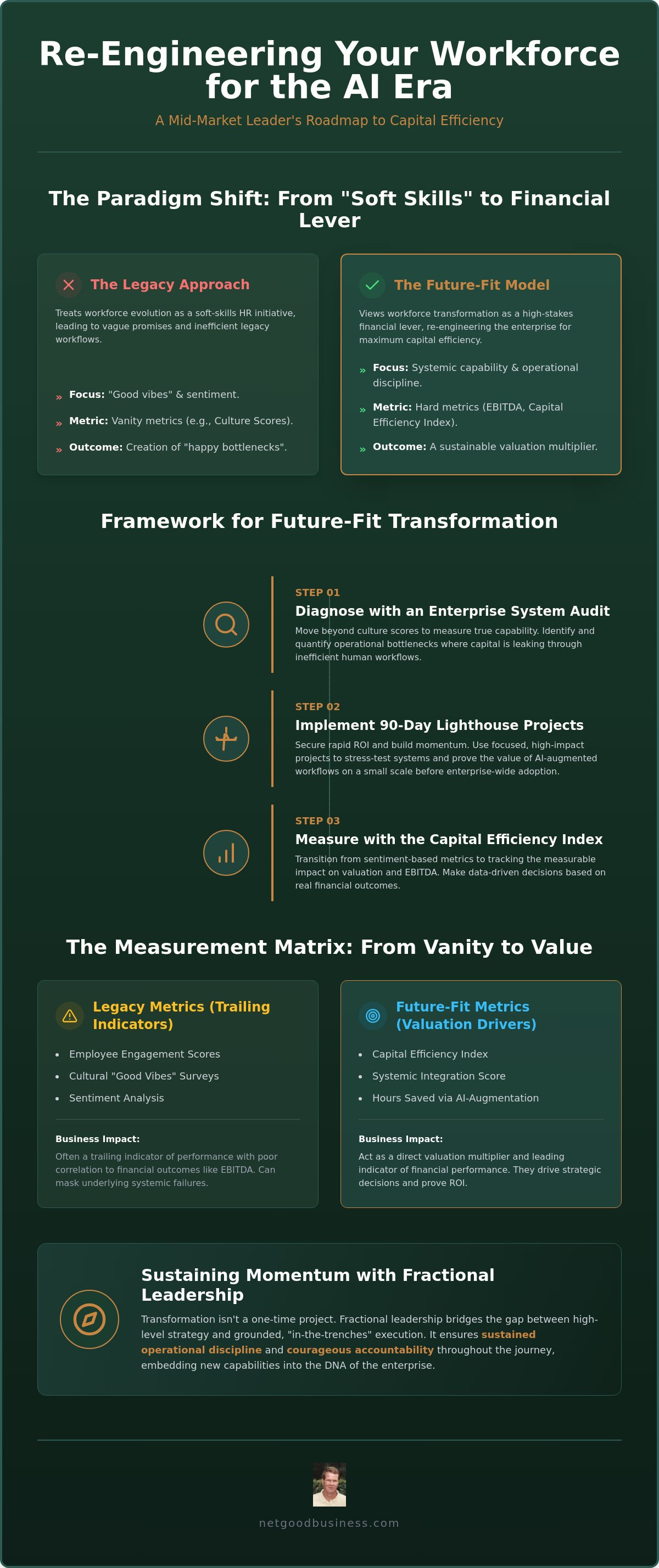
Measuring Success: Beyond Culture Scores to Capital Efficiency
Stop measuring happiness and start measuring output. If your current consultants are focused on employee sentiment scores, they're managing a luxury, not a business. Sentiment is a trailing indicator that often masks deep-seated operational rot. In high-stakes B2B environments, the only metric that matters is how effectively your human capital generates enterprise value. This is the fundamental differentiator of our approach to workforce transformation consulting. We replace "good vibes" with courageous accountability and hard financial metrics.
We prioritize the integration of systems over the satisfaction of legacy habits. While traditional consulting firms celebrate "engagement," we celebrate the reduction of drag on your EBITDA. We view the workforce as a component of a larger machine. If that component isn't producing a measurable return, it needs to be re-engineered. Success isn't found in a survey; it's found in the Capital Efficiency Index.
The Capital Efficiency Index Explained
The Capital Efficiency Index is your primary KPI for the AI era. It's a precise calculation of the ratio between your total output value and your human capital cost. When you integrate AI correctly, this index shifts dramatically in favor of the enterprise. You aren't just doing more with less; you're compounding the value of every hour worked. By 2026, mid-market B2B firms that fail to benchmark against this index will find themselves uninvestable. We track "Hours Saved" not as a productivity perk, but as a lead indicator of valuation growth. Every hour reclaimed from a manual, repetitive task is an hour that can be redirected toward high-leverage strategic initiatives that drive systemic integration.
Linking Transformation to Enterprise Value (EV)
Private Equity buyers don't pay for potential; they pay for proven, repeatable discipline. If you're preparing for a PE exit, your workforce must be a "Future-Fit" asset rather than a liability of legacy workflows. Buyers look for organizations where AI-human handoffs are seamless and documented. This operational discipline directly impacts your exit multiple by de-risking the transition and proving that your margins are sustainable. Our 12 to 18 month transformation timeline is designed to peak exactly when you need to show a valuation boost. We focus on the structural integrity of your team to ensure that your EBITDA margins aren't just higher, but are structurally protected against market volatility. To see how this applies to your specific portfolio, you can calculate your current Capital Efficiency Index and identify where your valuation is leaking.
The New Consulting Model: Why Fractional Leadership Wins
Traditional consulting is a hit-and-run disaster for the mid-market. Large firms often drop a massive strategy deck on your desk and vanish before the first workflow breaks. That isn't workforce transformation consulting; it's professional abandonment. Mid-market operators don't need more advisors. They need Strategic Architects who stick around to manage the friction of implementation and ensure structural integrity. Whether designing an enterprise system or a bespoke living environment, the value of professional consultation from experts like Neil Norton Design lies in their ability to bridge the gap between vision and execution. Fractional CXOs provide high-level executive expertise without the bloated overhead of a full-time C-suite salary. This model combines high-level strategic consulting with the "in-the-trenches" discipline required to actually move the needle on your valuation.
By 2026, the complexity of AI integration means that 88% of organizations are using AI in some capacity, yet only about 7% have successfully scaled it across the enterprise. This gap exists because companies lack the ongoing leadership discipline to see transformation through. A Fractional COO or CHRO doesn't just offer advice; they provide operational skin in the game. They act as a catalyst for systemic integration, ensuring that your workforce capability compounds over time rather than stagnating after the consultants leave the building.
Fractional Leadership vs. Traditional Consulting
The cost-benefit analysis of fractional leadership is undeniable for the mid-market B2B operator. With independent consultant rates averaging between $150 and $350 per hour for AI-specialized expertise in 2026, hiring a full-time executive team to manage transformation is often cost-prohibitive. Fractional leadership allows you to access top-tier talent for a fraction of the full-time salary. The advantages include:
- Courageous Accountability: Fractional leaders are judged on measurable outcomes, not hours billed.
- Strategic Architecture: They design systems that integrate people and AI into a single, efficient unit.
- Reduced Tech Debt: They ensure you don't buy "tech for tech's sake" but invest in tools that drive the Capital Efficiency Index.
Getting Started with Net Good Business
The journey to a Future-Fit enterprise starts with a single point of friction. We don't ask you to overhaul your entire organization on day one. We begin with a 90-day Lighthouse Project to solve a specific bottleneck and prove the ROI of our model. Once we've demonstrated a tangible impact on your EBITDA, we scale that capability across the entire enterprise. This methodical path ensures that every step of your transformation is funded by the efficiency gains of the previous phase. We align our success directly with your Capital Efficiency Index to ensure our interests are perfectly synchronized with yours. It's time to stop guessing and start engineering. You can Audit your Enterprise System for Future-Fit readiness today to identify exactly where your valuation is leaking.
Engineering Your Valuation Multiplier
Mid-market B2B leaders can't afford the luxury of inefficient legacy workflows anymore. Realizing enterprise value in the AI era requires a fundamental shift from sentiment-based HR to rigorous operational discipline. By utilizing the Capital Efficiency Index, you move beyond vanity metrics and begin treating your workforce as a high-performance system. This isn't a theoretical exercise; it's a structured path toward a documented valuation boost within 12 to 18 months. You now have the roadmap to turn your talent into a durable competitive advantage.
To further strengthen this advantage through strategic alignment, you can check out Redefine Brands Group for professional support in brand development and organisational transformation.
Effective workforce transformation consulting provides the fractional CXO support needed to bridge the gap between high-level strategy and "in-the-trenches" execution. You've seen how 90-day Lighthouse Projects fund your transformation journey while building the internal momentum for scaling. It's time to stop letting operational drag erode your EBITDA and start re-engineering your enterprise for capital efficiency. You can secure your Enterprise System Future-Fit assessment to start identifying exactly where your system is leaking value. The future belongs to the architects of efficiency. Build a capability that doesn't just survive disruption but compounds in value every single day.
Frequently Asked Questions
What is workforce transformation consulting and how does it differ from HR consulting?
Workforce transformation consulting is the strategic re-engineering of your enterprise system to maximize capital efficiency. Unlike HR consulting, which often focuses on sentiment, compliance, and culture scores, this approach treats the workforce as a financial lever. It aligns human workflows with AI automation to drive measurable enterprise value and structural integrity. If HR consulting is about "good vibes," workforce transformation is about "hard metrics."
How long does a typical workforce transformation take to show ROI?
You should expect to see the first signs of ROI within 90 days through a focused Lighthouse Project. While a full-scale Enterprise System Future-Fit transformation typically takes 12 to 18 months to fully realize a valuation boost, these initial wins fund the broader journey. We focus on rapid, high-impact sprints that deliver immediate EBITDA improvements and reclaimed capacity.
Why is AI integration critical for B2B workforce transformation in 2026?
AI integration is critical in 2026 because labor-intensive legacy models are becoming uninvestable. With 88% of organizations already using AI in some capacity, mid-market B2B firms must bridge the gap between simple pilots and enterprise-wide scale to remain competitive. AI isn't just a tool; it's a structural requirement for systemic integration and compounding value in a market that demands agility.
What are the key metrics to track during a workforce transformation?
The most important metric is the Capital Efficiency Index, which measures the ratio of output value to human capital cost. You should also track "Hours Saved" as a lead indicator of valuation growth and direct EBITDA impact. Move past vanity metrics like happiness scores and focus on the structural integrity of your operational workflows and their impact on enterprise value.
Can a mid-market company afford workforce transformation consulting?
Mid-market firms can absolutely afford workforce transformation consulting by utilizing fractional leadership models. Fractional CXOs provide high-level executive expertise for a fraction of the cost of a full-time hire. By starting with a 90-day Lighthouse Project, the transformation often pays for itself through immediate efficiency gains, making it a capital-efficient choice for growing firms.
What is a Fractional COO and how do they help with transformation?
A Fractional COO acts as a Strategic Architect who provides ongoing operational discipline without the full-time salary overhead. They have skin in the game, ensuring that transformation strategies aren't just designed but actually implemented. They are the catalyst for courageous accountability, preventing the "hit-and-run" failure common in traditional consulting by maintaining a grounded, "in-the-trenches" presence.
How does workforce transformation impact company valuation for Private Equity?
Workforce transformation acts as a significant valuation multiplier by de-risking the enterprise for potential buyers. Private Equity firms look for "Future-Fit" organizations where AI-human handoffs are seamless and EBITDA margins are structurally protected. A disciplined workforce capability makes your company more attractive during an exit by proving sustainable, scalable growth and operational excellence.
What is a 'Lighthouse Project' in the context of AI strategy?
A Lighthouse Project is a high-impact, 90-day sprint designed to solve a specific operational bottleneck using AI-human alignment. It serves as a low-risk entry point to prove ROI and build internal momentum for a full transformation. By selecting one high-leverage friction point, you demonstrate immediate value and secure the buy-in needed for enterprise-wide adoption.


