

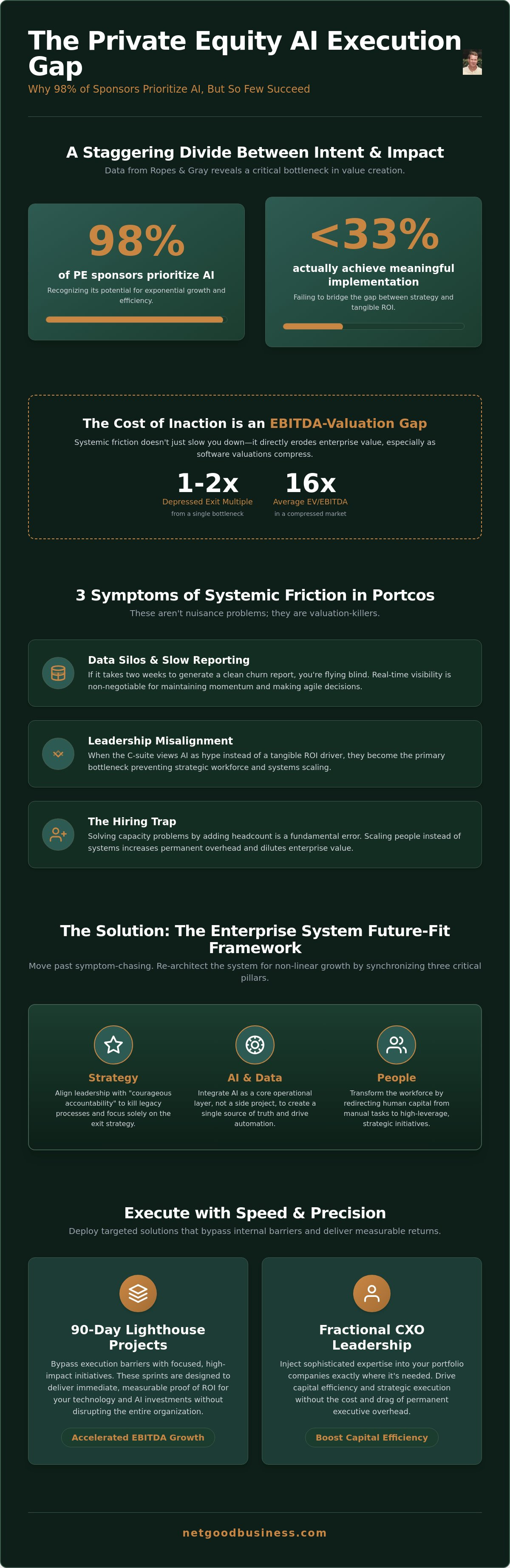
Why do 98% of private equity sponsors prioritize AI while fewer than one-third actually achieve meaningful implementation? It's a staggering execution gap reported by Ropes & Gray in June 2026. You've likely seen the same friction in your own portfolio: slow reporting cycles, misaligned leadership, and a workforce that can't scale. Throwing more capital at the problem won't fix it. Real growth requires disciplined operational bottleneck solutions for PE that move past the hype and focus on systemic integration.
You can't afford to wait for the next exit cycle to figure this out, especially with software valuations compressing to an average of 16x EV/EBITDA. This article provides a clear roadmap to bridge the divide between strategic intent and enterprise value. We'll explore how to leverage AI-driven strategy and fractional leadership to eliminate operational drag and boost your Capital Efficiency Index. You'll learn how to deploy 90-day Lighthouse projects that deliver measurable EBITDA growth without adding permanent overhead or falling into the trap of AI washing. If you want to accelerate value creation, you must stop managing symptoms and start re-architecting the system.
Key Takeaways
- Learn why legacy Six Sigma methods are too slow for the private equity window and how to identify systemic friction that prevents EBITDA expansion.
- Discover high-impact operational bottleneck solutions for PE by using the Enterprise System Future-Fit framework to synchronize strategy, data, and AI.
- Stop scaling through headcount and start leveraging AI workforce transformation to redirect your human capital toward high-leverage, strategic tasks.
- Execute 90-day Lighthouse projects to bypass internal execution barriers and provide immediate, measurable proof of ROI for your technology investments.
- Deploy fractional CXO leadership to inject sophisticated expertise into your portfolio companies, driving capital efficiency without the drag of permanent executive overhead.
The Private Equity Bottleneck: Why Traditional Operational Excellence is Failing
Traditional operational excellence is failing your portfolio. In the mid-market B2B space, applying 1980s manufacturing logic to a 2026 digital economy is a recipe for stagnation. Most operational bottleneck solutions for PE fail because they treat the symptoms rather than the system. They focus on incremental gains when the investment thesis demands exponential acceleration. If you're still relying on legacy frameworks, you're leaving enterprise value on the table.
Legacy methodologies like Lean or Six Sigma are often too slow. They require months of observation and cultural buy-in that simply doesn't exist in a high-velocity value creation window. PE doesn't have the luxury of time. Every week spent mapping processes without extracting value is a week of compounding cost. You need to apply the Theory of Constraints to the modern enterprise, identifying the single point of failure that throttles EBITDA growth across the entire portco. The goal isn't just to be "better"; it's to be efficient enough to win in a market where valuations have compressed to an average of 16x EV/EBITDA.
The EBITDA-Valuation Gap
Operational friction is the primary enemy of the PE hold period. It's not just a minor annoyance; it's a financial drain. A single systemic bottleneck in your lead-to-cash process or financial reporting can easily depress an exit multiple by 1-2x. Investors don't pay premium multiples for potential that's locked behind manual spreadsheets and fragmented departments. You must distinguish between nuisance problems, which are merely annoying, and valuation-killer bottlenecks that actively prevent you from hitting your Capital Efficiency Index targets.
Symptoms of Systemic Friction in Portcos
The cost of delayed decision-making in mid-market firms is compounding. If your leadership team is focused on hours worked instead of capital efficiency, they're missing the mark. Watch for these three specific symptoms:
- Data Silos: If it takes your portco two weeks to generate a clean churn report, you're flying blind. Real-time visibility is the only way to maintain momentum.
- Leadership Misalignment: When the C-suite views AI as hype rather than a tangible ROI tool, they create a bottleneck that prevents workforce scaling.
- The Hiring Trap: Solving a capacity problem by adding headcount is a fundamental error. If you're scaling people instead of systems, you're increasing permanent overhead and diluting enterprise value.
True operational bottleneck solutions for PE require shifting the focus from productivity to capital efficiency. It's about how much value each dollar of capital generates, not how many bodies are in the building. When you stop chasing "hours worked" and start optimizing for system throughput, the path to EBITDA expansion becomes clear.
The Enterprise System Future-Fit: A Framework for Identifying Systemic Friction
Most portcos treat bottlenecks as isolated incidents on a shop floor. This is a mistake. In the modern mid-market, systemic friction lives in the "soft" infrastructure: Sales Ops, Finance, and HR. The Enterprise System Future-Fit model redefines operational bottleneck solutions for PE by aligning three critical pillars: strategy, AI, and people. If these aren't synchronized, you're just moving the clog from one department to another.
Non-linear growth requires systemic integration. You can't achieve a 20% EBITDA expansion by tweaking isolated processes. You achieve it by removing the drag that slows down the entire enterprise. We use the Capital Efficiency Index to benchmark this performance. It's the ultimate diagnostic tool for PE firms because it measures the return on every dollar of operational spend, revealing exactly where friction is burning your cash.
Diagnosing the Strategic Layer
Friction starts at the top. If your executive team isn't aligned on Future-Fit goals, the rest of the organization will drift. We look for "courageous accountability" gaps. Is the CEO willing to kill legacy processes that no longer serve the exit strategy? Mapping strategic workflow bottlenecks requires more than a whiteboard; it requires an honest assessment of whether the leadership tier has the stomach for transformation.
The Technology and AI Friction Point
"AI-washing" is the new legacy tech debt. Many firms bolt on AI tools to broken processes, which only creates more complex bottlenecks. True transformation means evaluating how legacy debt prevents workforce scaling. AI should be a core workflow component, not a "bolt-on" addition. To see how this looks in practice, you can explore our Enterprise System Future-Fit program. It's designed to turn technology from a friction point into a strategic multiplier. If your tech stack doesn't directly contribute to compounding value, it's a liability, not an asset.
Solving Workforce Bottlenecks Through AI Transformation
Hiring more people is the reflex of a legacy mindset. In the private equity world, it's a trap. Adding headcount to solve a throughput issue only increases permanent overhead and complicates management structures. Effective operational bottleneck solutions for PE must address the human element by reallocating cognitive load, not just adding more bodies. When you transform the workforce through AI, you aren't just cutting costs. You're redirecting your most expensive assets, your people, toward high-value strategic tasks that actually move the needle on EBITDA.
Building organizational capability means making the portco Future-Fit from the bottom up. We don't look at productivity in a vacuum. Instead, we measure the "Hours Saved" metric as a leading indicator of EBITDA growth. If an AI agent can handle 40% of routine financial reconciliation or customer service tier-1 inquiries, those hours don't just disappear. They're reinvested into the system to drive compounding value. This is how you achieve the non-linear growth discussed in previous sections without the drag of a bloated payroll. It turns your workforce from a fixed cost into a scalable engine.
The AI Workforce Transformation Strategy
Success requires identifying repetitive cognitive tasks that act as operational anchors. These are the hidden bottlenecks in Sales Ops and HR that drain time without adding value. For mid-market B2B teams, the choice isn't just upskilling or augmenting; it's both. You must provide the tools to automate the mundane while training the team to manage the output. Cultural resistance is inevitable. However, when employees see AI reducing their administrative burden rather than threatening their seat, that resistance dissolves into adoption. It's about empowering the team to focus on what humans do best: complex problem solving and relationship management.
Optimizing Human Capital ROI
We use the Capital Efficiency Index to measure individual department productivity with surgical precision. It reveals the "management tax", the hidden cost of manual reporting and layers of oversight that AI can largely eliminate. By automating the flow of information, you reduce the need for mid-level coordination and free up the C-suite for high-stakes decision-making. AI capability is no longer a "nice-to-have" feature; it's a non-negotiable prerequisite for PE exit readiness in a market that demands operational maturity. If your portco can't demonstrate a tech-enabled workforce, you're signaling to future buyers that your margins are fragile and your systems are outdated.
The 90-Day Lighthouse Project: Accelerating ROI and Removing Execution Barriers
PE firms can't wait two years for an ERP implementation to bear fruit. If your investment thesis relies on rapid EBITDA expansion, you need a different approach. The 90-day Lighthouse Project is our answer to the slow-motion failure of traditional consulting. These are short-term, high-impact operational interventions designed to prove the AI business case in a fraction of the usual time. By narrowing the focus to a single, high-friction area, we bypass the organizational inertia that kills larger transformation efforts.
When searching for operational bottleneck solutions for PE, the goal isn't just to fix a process. It's to create a repeatable model for success. A Lighthouse Project selects a "High-Friction, High-Value" target, such as the Lead-to-Cash cycle or procurement automation, and applies a concentrated burst of AI-driven strategy and fractional leadership. Once you prove ROI in one department, scaling to the full Enterprise System Future-Fit becomes a matter of momentum rather than persuasion. It's about winning small to win big.
Phase 1: Identification and Scoping
We start by auditing the portco for the single most impactful bottleneck. We aren't looking for minor improvements; we're looking for the valuation-killer frictions that depress exit multiples. This phase requires setting "Courageous" KPIs that directly impact the bottom line. Board-level buy-in is non-negotiable here. You need the authority to move fast and break legacy habits that are holding the business back. If the executive team isn't ready to be held accountable for these metrics, the project won't move past the planning stage.
Phase 2: Execution and ROI Validation
During this phase, we deploy AI-driven workflows in a controlled environment to ensure stability and speed. We measure tangible outcomes like hours saved, drastic error reduction, and shortened cycle times. This isn't a theoretical exercise. We document the results into a "Playbook" that serves as the foundation for an enterprise-wide rollout. To see how we can trigger these results in your portfolio, you can start with one of our Quick Start Lighthouse Projects today. It's the fastest way to turn an operational drag into a competitive advantage.
By the end of the 90 days, you don't just have a report. You have a functioning, high-efficiency system that proves the value of your AI transformation strategy. This rapid validation removes execution barriers and gives the board the confidence to double down on what works. It turns operational excellence from a vague promise into a measurable financial asset. You stop guessing and start growing.
Fractional Leadership as a Strategic Multiplier for Capital Efficiency
The most dangerous bottleneck in a portfolio company isn't in the warehouse or the code. It's in the C-suite. Many mid-market executives possess deep industry knowledge but lack the "Future-Fit" skillset required to operationalize AI or drive rapid systemic change. This leadership gap creates a ceiling on EBITDA growth that no amount of capital can break. When looking for operational bottleneck solutions for PE, you must address whether your current leadership has the capacity to architect the systems you're paying for.
A Fractional COO or CHRO is often more effective for private equity than a full-time hire. You don't need a permanent executive with a massive severance package; you need a catalyst. Fractional leaders act as the bridge between the PE Board’s high-level financial targets and the Portco’s daily execution. They bring the courageous accountability required to ensure that momentum doesn't stall during the critical 12-18 months before an exit. They aren't there to maintain the status quo. They're there to disrupt it.
The Fractional CXO Advantage
Hiring a Tier-1 executive usually involves a six-month search and a compensation package that bloats the P&L. Fractional CXO services provide immediate access to that same caliber of talent without the overhead bloat. More importantly, an outsider perspective is vital for breaking through internal political bottlenecks. Internal leaders are often blinded by sentiment or legacy relationships. A fractional leader focuses on systems. They prioritize structural integrity and compounding value over internal politics or departmental protectionism. This objective approach is one of the most potent operational bottleneck solutions for PE firms facing "stuck" management teams.
Preparing for the Exit
Buyers pay a premium for durability. If your portco’s success depends on the specific heroics of a single founder or CEO, your exit multiple will suffer. You must build a scalable operational foundation where the system itself drives results. Ensuring the system survives a leadership transition is a core part of exit readiness. It transforms the business into a turnkey asset for the next owner. See how Net Good Business accelerates valuation through Fractional Leadership to turn your portco into a high-performance engine that functions independently of any single individual.
Maintaining operational discipline during the exit prep phase is non-negotiable. As you approach the 16x EV/EBITDA average mentioned previously, every point of friction is a liability. By deploying fractional leadership, you ensure that the transformation is baked into the company's DNA. You aren't just dressing up the books for a sale. You're delivering a future-fit enterprise that is demonstrably efficient, technologically advanced, and ready for the next stage of growth. This is how you maximize enterprise value in the AI era.
Architecting the Future of Private Equity Value Creation
The era of relying on multiple expansion as a primary growth lever has passed. In a market where valuations are tightening, EBITDA growth depends on surgical precision and systemic integration. You've seen how legacy methodologies fail to meet the high-velocity demands of the PE hold period. By adopting the Enterprise System Future-Fit framework, you can identify hidden drag in the strategic and technological layers of your portcos. This isn't about incremental gains; it's about re-architecting the system for non-linear growth.
Implementing effective operational bottleneck solutions for PE requires a shift from scaling headcount to optimizing human capital ROI through AI transformation. Whether you're deploying a 90-day Lighthouse project to secure a rapid ROI guarantee or leveraging fractional leadership to maintain momentum, the goal remains the same: a durable, scalable enterprise. Benchmarking your performance with the Capital Efficiency Index provides the clarity needed to lead with courageous accountability. Your next exit multiple is being determined by the operational discipline you instill today. Maximize your portfolio value with Net Good Business and turn systemic friction into compounding value. Your exit valuation depends on the systems you build now.
Frequently Asked Questions
How do PE firms identify operational bottlenecks in mid-market companies?
PE firms identify bottlenecks by looking for "strategic drag" where operational spend doesn't translate into EBITDA growth. We use a systemic diagnostic that evaluates the interplay between leadership, technology, and workforce capability. Effective operational bottleneck solutions for PE start by auditing data silos and reporting delays that prevent real-time visibility. If a portco can't produce a clean financial health report within 48 hours, you've found a systemic friction point.
What is the Capital Efficiency Index and why does it matter for PE?
The Capital Efficiency Index is a core health metric that measures the return on every dollar of operational expenditure. It matters because traditional P&L statements often hide the "management tax" and systemic inefficiencies that drain cash. By benchmarking this index, sponsors can see exactly where friction is burning capital. It provides a grounded, data-driven view of portco health that goes far beyond surface-level productivity metrics.
How long does it take to see ROI from an AI-driven operational transformation?
You should see measurable ROI within 90 days. While legacy ERP implementations often take 12 to 24 months to deliver value, high-impact interventions focus on rapid validation. By targeting high-friction areas first, we prove the business case and extract value quickly. This speed is essential for the private equity hold period where every month of delayed efficiency compounds the cost of the investment.
What are the most common bottlenecks in PE-backed B2B service firms?
The most common bottlenecks are slow lead-to-cash cycles, manual financial reconciliation, and the "hiring trap." Many mid-market firms try to solve capacity issues by adding headcount, which only increases overhead and management complexity. These firms often suffer from fragmented data systems that prevent leadership from making fast, informed decisions. These systemic frictions act as anchors that prevent non-linear growth and depress exit valuations.
Why is fractional leadership better than traditional management consulting for PE?
Fractional leadership is superior because it focuses on execution and skin-in-the-game accountability rather than just delivering slide decks. Traditional consultants often lack the operational authority to implement change. A fractional CXO provides Tier-1 expertise and drives operational bottleneck solutions for PE from the inside. They build the systems, train the teams, and ensure the transformation is durable enough to survive an exit.
Can AI transformation really increase a company's exit multiple?
Yes, it can. Buyers in 2026 pay a premium for businesses that demonstrate "Future-Fit" operational maturity and reduced reliance on manual labor. An AI-enabled workforce signals that the company's margins are protected and its growth is scalable. By documenting these technology-driven efficiencies in a playbook, you provide proof of a durable system. This reduces the buyer's perceived risk and justifies a higher EV/EBITDA multiple.
What is a Lighthouse project in the context of operational improvement?
A Lighthouse project is a 90-day, high-impact intervention designed to solve a specific, high-friction problem. It acts as a proof of concept for the broader Enterprise System Future-Fit program. By focusing on a narrow scope, like automating sales operations or procurement, we bypass organizational resistance and deliver immediate EBITDA impact. It's the "quick win" that builds the momentum needed for enterprise-wide transformation.
How does the Enterprise System Future-Fit model differ from Lean or Six Sigma?
The Future-Fit model focuses on speed and digital integration rather than the slow, incremental gains of legacy manufacturing frameworks. Lean and Six Sigma are often too methodical for the compressed PE value creation window. Our model prioritizes AI-driven strategy and systemic alignment to achieve non-linear growth. We move past the shop floor to solve bottlenecks in the cognitive and strategic layers of the enterprise.

