

Revenue growth has become the ultimate vanity metric in a market that now demands surgical precision over raw scale. If your enterprise value is stagnating while your top line climbs, you aren't growing; you're just getting heavier. You've likely felt the weight of operational bloat or the nagging uncertainty of whether your AI investments are actually moving the needle on margins. To win in 2026, you must pivot from a "growth at all costs" mentality to a disciplined focus on the capital efficiency index for business.
We agree that the traditional consulting playbook is broken. It's time for a diagnostic that provides courageous accountability and clear financial targets. This guide will show you how to master the metrics that transform operational discipline into exponential enterprise value. We'll explore how to leverage the Rule of 40 and optimize your burn multiples to secure a premium valuation. You'll learn to justify every strategic investment through the lens of margin expansion, ensuring your business is exit-ready within the next 12 to 18 months.
Key Takeaways
- Learn why the capital efficiency index for business is the ultimate "North Star" for measuring real enterprise value created per dollar of capital invested.
- Discover why traditional EBITDA is a lagging indicator and how to prioritize strategic metrics that capture the value of AI-driven workflows.
- Identify the specific operational levers needed to eliminate the "friction tax" in your B2B processes and significantly reduce the cost of goods sold.
- Master the 12-18 month roadmap for the Enterprise System Future-Fit program to maximize your valuation multiples before a planned exit.
- Understand how fractional leadership provides the strategic architecture needed to implement these disciplined systems without adding permanent executive overhead.
What is the Capital Efficiency Index for Business?
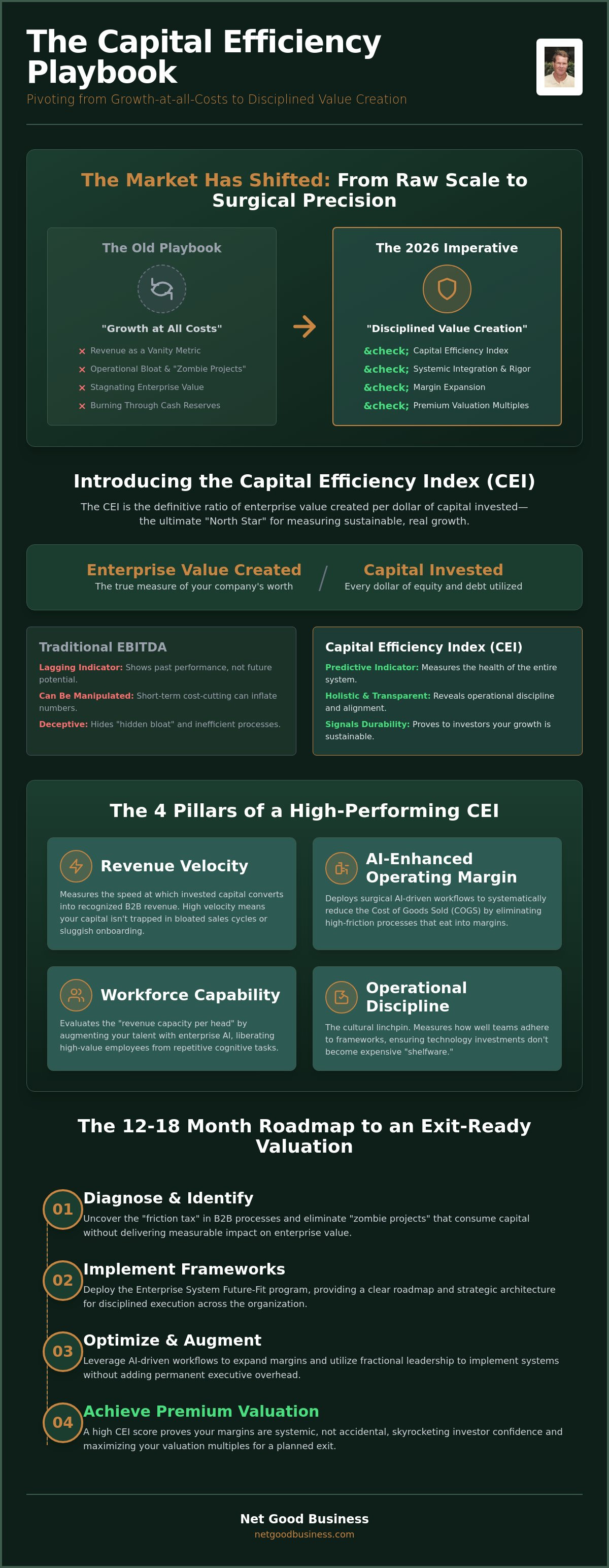
The Capital Efficiency Index (CEI) is the definitive ratio of enterprise value created per dollar of capital invested. It is a cold, hard look at how effectively your organization converts resources into valuation. While traditional EBITDA remains a staple of the income statement, it's often a deceptive, lagging indicator. Profitability can be manufactured through short-term cost-cutting that hollows out long-term growth. In contrast, the capital efficiency index for business measures the health of the entire system, revealing whether your growth is sustainable or merely a result of burning through cash reserves.
The 2026 market has no patience for inefficiency. With the bank prime loan rate sitting at 6.75% and the federal funds effective rate at 3.62%, the cost of capital has fundamentally shifted the "Valuation Imperative." Private equity firms and strategic buyers are no longer hunting for raw revenue at any cost. They're looking for businesses that can demonstrate a high marginal efficiency of capital. The CEI serves as the primary diagnostic tool for operational discipline and strategic alignment, filtering out the noise of top-line growth to reveal the core engine of value creation.
The Shift from Growth-at-all-Costs to Capital Discipline
The era of "cheap money" didn't just end; it collapsed under the weight of rising interest rates and a global demand for margin expansion. In mid-market B2B firms, this transition often exposes "hidden bloat" within middle management and fragmented tech stacks. We frequently see organizations running "zombie projects," which are initiatives that consume significant capital and executive bandwidth without ever returning a measurable impact on enterprise value. By applying the capital efficiency index for business, leaders can identify these bottlenecks and reallocate resources to high-velocity workflows that actually compound value.
Why the Index Matters for Enterprise Value (EV)
Valuation is a game of multiples, and efficiency is the ultimate multiplier. A high CEI score signals to the market that your business is a well-oiled machine capable of weathering volatility. This level of discipline drives multiple expansion because it reduces risk. When PE partners see a high index score, their confidence in your 12-18 month exit strategy skyrockets. It proves that your margins aren't accidental; they're a result of systemic integration and operational rigor. In a volatile B2B landscape, the CEI isn't just a metric; it's a predictor of long-term durability and structural integrity.
Core Components of a High-Performing Capital Efficiency Index
Building a resilient enterprise requires more than just watching the bottom line. It requires a granular understanding of the levers that drive the capital efficiency index for business. Unlike static accounting reports that only show where money went, a high-performing index acts as a dynamic map of where value is being created in real time. We focus on four critical pillars: Revenue Velocity, AI-Enhanced Operating Margin, Workforce Capability, and Operational Discipline.
Revenue Velocity measures the speed at which invested capital converts into recognized B2B revenue. If your sales cycle is bloated or your onboarding is sluggish, your capital is trapped. AI-Enhanced Operating Margin then addresses the cost side by deploying AI-driven workflows to systematically reduce the cost of goods sold (COGS). This isn't about generic automation. It's about surgical strikes on high-friction processes that eat into your margins. When these two components align, you stop leaking value and start compounding it.
The human element is captured through the Workforce Capability Score. This metric evaluates the efficiency of your talent when fully augmented by enterprise AI. Finally, Operational Discipline serves as the "soft" metric that determines how well your team adheres to the Enterprise System Future-Fit framework. Without this cultural alignment, even the best technology becomes shelfware. Leaders who struggle to bridge this gap often benefit from Fractional CXO Services to provide the necessary strategic architecture.
Integrating AI Workforce Transformation into the Metric
Stop measuring "hours saved" and start measuring "revenue capacity per head." A true AI workforce transformation doesn't just make people faster; it expands the ceiling of what your existing team can produce. We identify high-leverage automation points where AI can take over repetitive cognitive tasks. This shift liberates your high-value talent to focus on strategic growth and relationship management. The result is a sustainable efficiency gain that scales without a linear increase in payroll.
The Financial Bedrock: CAC, LTV, and Burn Multiples
Mid-market B2B service firms must adapt SaaS-style discipline to survive. As of July 2026, venture capital investors are screening for a Burn Multiple of less than 1.5x before even taking a first meeting. Your customer acquisition cost (CAC) must be weighed against long-term strategic alignment rather than just volume. We also look at the Rule of 40, which is the sum of your growth rate and profit margin. In the current market, companies with a Rule of 40 score of 40% or higher trade at 2.3x the revenue multiples of their less efficient peers. For non-venture companies, calculating the capital efficiency index for business using these benchmarks ensures survival and prepares the foundation for a high-premium exit.
Standard Metrics vs. Strategic Intelligence: A Comparison
Accounting metrics are post-mortems. They tell you exactly what happened last quarter, but they offer zero insight into whether your current trajectory will actually result in a premium exit. To maximize valuation, you must shift from reporting metrics to strategic intelligence. The capital efficiency index for business isn't just another line on a spreadsheet; it's an execution engine. While traditional Return on Invested Capital (ROIC) focuses on tangible assets, it fails to account for the compounding value of AI-driven intangible assets. If you've automated a core B2B workflow, that asset doesn't appear on a standard balance sheet, yet it's the primary driver of your future margin expansion.
Cost-cutting is a defensive maneuver. It's a "slash and burn" approach that often destroys the very capabilities required for growth. Capital efficiency is offensive. It's about optimizing the system so that every dollar of input generates a disproportionate amount of enterprise value. We've categorized the differences below to show why traditional math is failing the modern executive.
| Feature | Traditional Accounting | Capital Efficiency Index |
|---|---|---|
| Orientation | Backward-looking (Reactive) | Forward-looking (Predictive) |
| Primary Goal | Profit Reporting | Enterprise Value Creation |
| Focus | Cost Control | Systemic Integration |
| AI Treatment | Operating Expense | Strategic Valuation Lever |
Why EBITDA is No Longer Enough for PE Portfolios
EBITDA is a blunt instrument. Private equity firms are increasingly skeptical of "EBITDA engineering," where a CEO cuts R&D or critical middle management just to hit a quarterly target. This practice hollows out the organization and creates a "technical debt" that the next buyer will have to pay for. The capital efficiency index for business provides courageous accountability by showing the board exactly where capital is being wasted on friction rather than being converted into velocity. It reveals the health of the underlying enterprise system, ensuring that your numbers are backed by structural integrity, not just clever accounting.
The Future-Fit Advantage: Predictive vs. Reactive Tracking
The Enterprise System Future-Fit model turns the CEI into a predictive tool. By monitoring the index, we can forecast valuation 12 to 18 months in advance with high precision. We look for "operational drift," which are the small, silent inefficiencies in B2B processes that eventually manifest as a P&L crisis. Identifying these warning signs early allows for surgical corrections before they hit your bottom line. Maintaining this level of index integrity requires constant vigilance; it's why many mid-market firms utilize Fractional CXO Services to bridge the gap between high-level strategy and daily execution.
Improving Your Index Score: Operational Levers for Leaders
Improving your index score is not a defensive retreat. While some industry voices suggest scaling back growth to fix efficiency, we view it as a strategic offensive. Improving the capital efficiency index for business requires a surgical focus on four primary levers that transform stagnant operations into high-velocity engines. You aren't just trying to survive; you're trying to outpace the competition by doing more with every dollar of capital.
First, AI Workforce Transformation must move beyond simple automation. It should systematically eliminate "boring" cognitive tasks to liberate your highest-value talent for strategic work. Second, you must enforce Operational Discipline. This means identifying and killing the "friction tax" created by poorly defined B2B processes that slow down revenue velocity. Third, leveraging Fractional Executive Leadership allows you to inject Tier-1 strategic architecture into your firm without the $400k plus salary bloat. Finally, we use Quick Start Lighthouse Projects to validate capital allocation in 90-day sprints.
Eliminating Operational Bottlenecks with Lighthouse Projects
Transformation fails when it tries to do too much at once. We identify the single biggest bottleneck dragging down your index score and attack it with a 90-day "Lighthouse" framework. These sprints provide rapid ROI and, more importantly, create the cultural buy-in necessary for enterprise-wide change. If you can't prove the value of a system in one quarter, it's likely a "zombie project" that needs to be decommissioned. Success in these small-scale environments provides the blueprint for scaling efficiency across the entire organization.
The Role of Fractional CXOs in Scaling Efficiency
Mid-market firms often lack the strategic architecture required to sustain a high capital efficiency score. Hiring a full-time, Tier-1 COO or CHRO is often an inefficient use of capital for companies in the 12-18 month exit window. Fractional leaders provide the same level of discipline and systems-thinking at a fraction of the cost. They act as the primary architects of your capital efficiency index for business, ensuring that every operational change is aligned with your ultimate valuation goals. They provide the courageous accountability needed to keep the board and the executive team focused on compounding value.
If you're ready to stop the operational drift and start building a high-velocity enterprise, explore how our Fractional CXO Services can architect your path to peak valuation.
Implementing the Capital Efficiency Index with Net Good Business
Implementing the capital efficiency index for business is not a passive exercise in data collection. It is a fundamental rewiring of your organizational DNA. At Net Good Business, we don't just hand you a report; we deploy the Enterprise System Future-Fit framework to transform your current operational state into a high-valuation engine. This 12 to 18 month roadmap is designed to move your firm from the chaos of fragmented growth to the precision of disciplined scale.
We begin with a comprehensive enterprise-wide assessment. We look past the P&L to find the structural friction that traditional accounting hides. By using the CEI as our North Star, we align your strategy, AI integration, and human talent under a single, measurable metric. This ensures that every dollar of capital and every hour of labor is working toward a singular goal: compounding your enterprise value. The transition from chaos to disciplined growth isn't accidental; it's architected.
The 12-18 Month Valuation Imperative
The journey to peak valuation requires more than just better software. It requires a synchronized alignment of strategy, AI, and people. We work with your leadership through Executive Coaching to sustain the operational discipline necessary for long-term success. This isn't just about efficiency; it's about culture. When your team sees that AI is liberating them from the "boring" tasks rather than replacing them, culture scores rise alongside your margins. You can expect a tangible increase in company valuation as the market begins to price in your systemic durability and structural integrity.
Getting Started: The First 90 Days
The first 90 days are critical for establishing momentum and proving the model. We move quickly from the initial assessment to launching your first Quick Start Lighthouse Project. This serves two purposes: it validates our capital allocation strategy and proves the ROI of AI-driven workflows to your board. By establishing a baseline capital efficiency index for business in month one, we create a clear diagnostic for business health. We then spend the next two quarters refining the system and scaling the results across the enterprise.
Don't leave your exit multiple to chance. It's time to stop measuring the past and start architecting the future of your firm. Audit your enterprise value with Net Good Business to see exactly where your efficiency gaps are hiding.
Architecting Your 12-Month Exit Strategy
The 2026 market has no room for operational drift or unverified growth. You've seen how the capital efficiency index for business acts as the ultimate diagnostic for enterprise health. It moves past the deceptive simplicity of EBITDA to reveal the true engine of value creation. By integrating AI-driven workforce transformation and enforcing rigorous operational discipline, you transform your company from a collection of silos into a high-velocity system.
Our proven 12-18 month valuation growth roadmap provides the precise strategic architecture you need to secure a premium exit multiple. We deliver this through Fractional CXO Services, ensuring your mid-market firm scales without the burden of executive-level salary bloat. It's time to stop reacting to the P&L and start architecting a durable, high-value legacy. Success in this landscape isn't about working harder; it's about making your capital work smarter through systemic integration.
Drive Enterprise Value with the Future-Fit Framework
Your path to peak valuation is a matter of systemic alignment and courageous accountability. Let's build it.
Frequently Asked Questions
What is a good Capital Efficiency Index score for a B2B company in 2026?
A Rule of 40 score of 40% or higher remains the gold standard for B2B firms in 2026. Companies achieving this benchmark currently trade at 2.3x the revenue multiples of their less efficient peers. For those seeking venture capital, investors are now screening for a Burn Multiple below 1.5x as a prerequisite for initial meetings.
How does the Capital Efficiency Index differ from Return on Equity (ROE)?
The capital efficiency index for business measures enterprise value creation per dollar invested, while Return on Equity (ROE) measures net income relative to shareholder equity. ROE is an accounting metric that can be manipulated through debt or buybacks. The CEI is a strategic execution metric that reveals the structural integrity of your operating model.
Can a company be too capital efficient and miss out on growth opportunities?
It's possible to over-optimize for efficiency if you treat it as a cost-cutting exercise rather than a velocity play. However, a true CEI measures the speed of value creation. If you starve the business of necessary growth capital, your revenue velocity will stall, causing your overall index score to decline despite lower spending.
What is the fastest way to improve a Capital Efficiency Index score?
The most immediate lever is the decommissioning of "zombie projects" that consume capital without contributing to enterprise value. We use 90 day Lighthouse Projects to identify these bottlenecks and reallocate resources to high-velocity workflows. This surgical approach provides an immediate boost to your burn multiple by eliminating systemic waste.
How do AI investments impact the Capital Efficiency Index in the short term?
AI investments often create a temporary drag on the capital efficiency index for business due to upfront implementation and training costs. This is a strategic trade-off. The goal is long-term margin expansion through the reduction of COGS, which eventually drives a disproportionate increase in valuation as AI-driven workflows scale across the organization.
Why do Private Equity firms care more about the CEI than simple revenue growth?
Private Equity firms prioritize the CEI because it is the primary driver of multiple expansion. Revenue growth can be bought with excessive spending, which increases risk and hollowing out margins. A high index score proves that the business is a disciplined system capable of compounding value regardless of broader market volatility.
Is the Capital Efficiency Index applicable to non-SaaS B2B service companies?
The index is critical for service firms where human capital is the primary cost and largest source of friction. In these environments, the CEI reveals how effectively you are augmenting talent with AI to increase revenue capacity per head. It brings the same valuation rigor to services that the Rule of 40 brought to software.
How often should a mid-market board review their Capital Efficiency Index?
Boards should conduct a formal review of the index every quarter, while the executive team tracks it monthly. This frequency allows you to identify operational drift before it manifests as a crisis in the P&L. Regular reviews ensure the organization stays locked into its 12-18 month roadmap toward a high-premium exit.

