

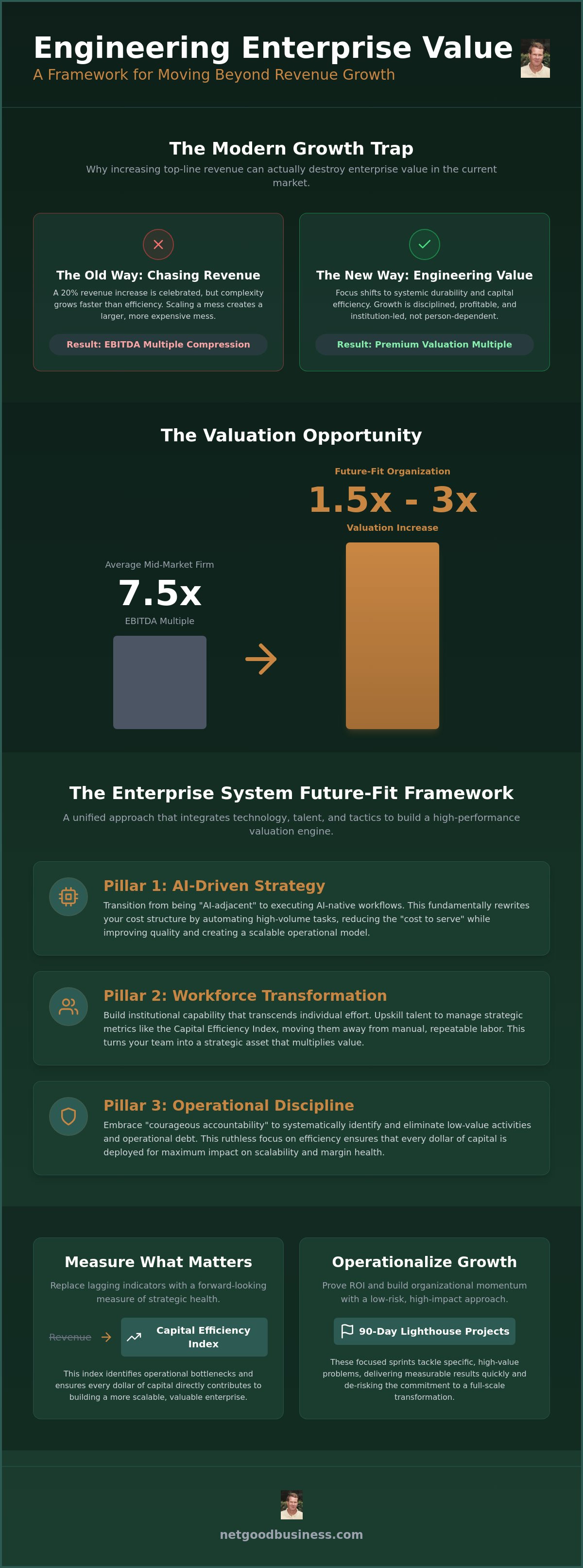
Revenue growth is a vanity metric if it doesn't translate into a compounding valuation multiple. While the average mid-market business service firm currently sits at a 7.5x EBITDA multiple, the 2026 market is increasingly punishing companies that lack structural scalability. You've likely felt the frustration of stagnant valuations despite hitting your sales targets. It's a common trap where AI initiatives feel like cost centers and the workforce views digital transformation as a threat. To break this cycle, you need a rigorous enterprise value growth framework that moves beyond surface-level improvements.
We recognize that navigating 6.75% prime rates and shifting buyer behaviors requires more than just grit; it requires a systemic overhaul. This article provides the roadmap to a 1.5x to 3x valuation increase by aligning your Capital Efficiency Index with a "Future-Fit" workforce strategy. We'll unpack how to integrate AI-driven efficiency with institutional capability to transform your organization into a high-performance engine that commands a premium in any economic climate. It's time to stop chasing revenue and start engineering value.
Key Takeaways
- Stop chasing vanity metrics and learn why revenue growth without systemic efficiency actually destroys enterprise value in the current economic climate.
- Implement an enterprise value growth framework that integrates AI-native workflows with workforce capability to drive a measurable valuation premium.
- Replace lagging indicators with the Capital Efficiency Index to identify operational bottlenecks and ensure every dollar of capital is working toward scalability.
- Execute 90-day Lighthouse Projects to prove ROI and build organizational momentum before committing to a full-scale digital transformation.
- Access Fractional CXO services to provide the strategic architecture and operational skin in the game needed to engineer a successful 1.5x to 3x valuation increase.
Beyond the Formula: Why Traditional Growth Fails to Build Enterprise Value
Most executives view Enterprise Value as a static accounting output; market cap plus debt minus cash. In 2026, this definition is dangerously incomplete. True enterprise value is a measure of systemic durability. It's the market's assessment of how likely your profits are to persist without your constant intervention. If your business requires heroic individual effort to maintain its trajectory, your valuation will suffer a "key person" discount that no amount of revenue can fix.
Many mid-market B2B firms fall into the "Growth Trap." They increase top-line revenue by 20% but see their EBITDA multiples compress because their complexity grew faster than their efficiency. Scaling a mess doesn't create value; it creates a larger, more expensive mess. To avoid this, leaders must adopt a disciplined enterprise value growth framework that prioritizes margin health over raw volume. Growth at all costs is a relic of a low-interest-rate past. Today, the focus is on capital efficiency.
Investors perform a rigorous attribution analysis to see where your success actually originates. Does it stem from a proprietary system, or does it live in the heads of three senior sales reps? If your growth relies on individual relationships rather than institutionalized processes, your valuation carries a significant discount. Institutional capability is the ultimate valuation multiplier. It proves the business is a machine, not a collection of talented individuals.
The Difference Between Revenue Growth and Valuation Growth
Private equity firms look past top-line numbers to assess "quality of earnings." They want to know if your revenue is "sticky" or merely "transactional." In 2026, transactional revenue is a commodity. Sticky revenue, backed by high Net Revenue Retention (NRR), commands the highest multiples. While the median NRR for SaaS is 106%, top-performing firms exceed 130%. Operational debt, the hidden cost of manual workarounds and fragmented data, silently erodes your exit potential. It signals to buyers that the business is fragile and requires significant post-acquisition investment.
The 2026 Valuation Imperative: AI and Systemic Integration
Being "AI-adjacent" is no longer enough to secure top-tier multiples. It's the baseline. High-valuation firms have shifted from labor-heavy models to AI-augmented structures where technology handles the heavy lifting of forecasting and support. This transition requires a robust enterprise value growth framework to ensure technology doesn't become a standalone cost center. Systemic Integration is the precise alignment of technological infrastructure, human capability, and strategic intent to create a self-reinforcing engine of growth.
The Enterprise System Future-Fit: A Three-Pillar Framework
Most mid-market firms treat AI as a tech initiative, people as an HR project, and strategy as a board-level exercise. This fragmentation is a valuation killer. The enterprise value growth framework we deploy, the Enterprise System Future-Fit, forces these silos into a single operational banner. It's not about adding more complexity; it's about achieving systemic precision. To command a premium multiple in 2026, your organization must operate as a unified machine where tech, talent, and tactics are indistinguishable.
Our framework rests on three non-negotiable pillars:
- AI-Driven Strategy: Moving from "using tools" to executing AI-native workflows that fundamentally rewrite your cost structure.
- Workforce Transformation: Upskilling talent to manage the Capital Efficiency Index rather than performing manual, repeatable labor.
- Operational Discipline: The "courageous accountability" required to identify and eliminate low-value activities that bloat the balance sheet.
Pillar 1: AI Strategy as a Valuation Multiplier
In the current market, "AI-adjacent" is a failing grade. To scale EBITDA, you must reduce the "cost to serve" while maintaining or improving service quality. AI-native workflows achieve this by automating high-volume, low-complexity tasks that previously required human intervention. We don't advocate for massive, multi-year tech bets. Instead, we recommend starting with Quick Start Lighthouse Projects. These 90-day sprints prove ROI and build the internal momentum needed for enterprise-wide integration. When AI handles 30% of your operational forecasting, your multiple doesn't just grow; it compounds.
Pillar 2: Building Organizational Capability Through AI
Technology is a force multiplier, but zero multiplied by anything is still zero. If your workforce is resistant or lacks the literacy to manage automated systems, your investment is wasted. Modernizing culture means moving to "AI-first" thinking. We use Culture Scores as a proxy for operational agility, measuring how quickly a team adopts and iterates on new digital workflows. This isn't a bottom-up request; it's a top-down mandate. Through targeted Executive Coaching, we ensure your leadership team has the "Strategic Architect" mindset required to drive this level of transformation. If your people aren't "Future-Fit," your enterprise value growth framework will collapse under its own weight.
Pillar 3, Operational Discipline, is the final safeguard. It requires a ruthless commitment to metrics. If a process doesn't directly improve your Capital Efficiency Index, it's a candidate for elimination. This level of discipline signals to private equity buyers that your business is a high-performance engine, not a fragile collection of legacy habits.
Measuring Strategic Health: The Capital Efficiency Index
EBITDA is a comfortable lie. It provides a static snapshot of profitability while often masking the operational rot that devalues your company during a rigorous due diligence process. If your EBITDA is growing but your headcount is keeping pace, you aren't actually scaling; you're just getting larger and more fragile. This is why a disciplined enterprise value growth framework relies on the Capital Efficiency Index (CEI) as the primary diagnostic for mid-market health. Developed by Net Good Business, the CEI moves beyond lagging financial indicators to measure the real-time performance of your operational engine.
The CEI tracks the ratio of value output to the total capital consumed to produce it. In 2026, this must include a precise accounting of AI-driven labor savings and technology debt. For private-equity-backed B2B firms, "good" is no longer defined by a simple margin percentage. It's defined by a CEI that demonstrates a compounding return on every dollar of human and technological capital. If your CEI is stagnant while your competitors use AI-native workflows to decouple revenue from headcount, your valuation multiple will inevitably contract regardless of your top-line growth.
Calculating Your Capital Efficiency Index
The formula is straightforward but demanding: [Value Output / (Human Capital + Technology Spend)]. Value output isn't just top-line revenue; it's the total economic benefit generated by the system. To find your true CEI, you must identify "Value Leaks," which are those legacy manual processes that drain capital without contributing to long-term scalability. Using this metric allows you to move away from subjective arguments when requesting budget from the Board. It provides the hard data needed to justify further AI investments by showing exactly how technology spend will improve the ratio over a 12 to 18-month horizon.
CEI vs. EBITDA: A Comparative Analysis
A high EBITDA with a low CEI indicates a "fragile" valuation. It suggests that the business is being held together by expensive, manual effort that likely won't survive a leadership transition or a market downturn. Conversely, a rising CEI is a leading indicator of future margin expansion. It proves that the enterprise value growth framework you've implemented is actually working. When you present your business to potential acquirers, defending a higher multiple becomes significantly easier when you can demonstrate a superior CEI. You aren't just selling them today's cash flow. You're selling them a highly efficient, durable system that is engineered for future growth.
- Lagging vs. Leading: EBITDA tells you what happened; CEI tells you what is possible.
- Fragility vs. Durability: CEI exposes the hidden costs of operational debt.
- Valuation Defense: Use CEI to prove your business is an efficient machine, not a collection of people.
Operationalizing Growth: From Lighthouse Projects to Fractional Leadership
Hiring is a blunt instrument. If you add ten people to a broken process, you've simply scaled your inefficiency and compressed your multiple. In a 2026 market defined by 6.75% prime rates and lengthening sales cycles, you don't have the luxury of "growth at all costs." Our enterprise value growth framework is designed to engineer systemic durability over a 12 to 18-month horizon. It's a methodical journey that replaces manual "heroics" with automated, high-margin workflows.
The goal isn't just to grow; it's to build a business that is "Future-Fit." This means creating an organization that is attractive to private equity because it operates independently of any single leader. We achieve this by avoiding the "Consultancy Trap." Instead of creating perpetual dependence on outside advisors, we focus on building your internal capability. We provide the strategic architecture, but your team learns to manage the engine.
Step 1: The Quick Start Lighthouse Project
Most digital transformations fail because they attempt too much too soon. We favor a "90-day win" strategy through our Quick Start Lighthouse Projects. We identify a single, high-friction bottleneck, such as procurement bottlenecks or fragmented sales operations, and apply AI-native workflows to solve it. This isn't a theoretical pilot; it's a hard-coded operational improvement. We set measurable KPIs from day one, focusing on hours saved, error reduction, and cycle time. Once the ROI is proven in one department, we use that success as the blueprint for scaling systemic integration across the broader organization.
Step 2: Leveraging Fractional Executive Services
Mid-market firms often find themselves in a leadership gap. They need the strategic sophistication of a veteran executive but can't justify the $300,000 plus price tag of a full-time C-suite hire. This is where Fractional CXO Services become a valuation multiplier. A Fractional COO provides the operational discipline required for PE portfolio optimization, while a Fractional CHRO drives workforce transformation without the bloated overhead. These leaders aren't mere consultants; they are "Strategic Architects" with operational skin in the game. They ensure every department is aligned with the Capital Efficiency Index, turning strategy into measurable valuation increases. To start engineering your exit with high-level expertise, explore our Fractional CXO Services today.
By the end of the 18-month roadmap, the business has transitioned from a labor-heavy model to an AI-augmented structure. You've moved from "using tools" to "executing workflows." The result is a durable, scalable enterprise that commands a premium multiple because its success is systemic, not accidental.
The Net Good Business Solution: Engineering Your Exit
Net Good Business exists to bridge the chasm between high-level strategic theory and the "in-the-trenches" reality of mid-market operations. We don't just deliver a slide deck and exit the building. We act as Systemic Architects, providing the technical blueprint and the operational skin in the game required to transform your organization. By deploying our proprietary enterprise value growth framework, we ensure your organization is optimized for a 2026 market that demands both AI-native efficiency and capital discipline. We don't settle for superficial improvements; we engineer durable assets that command premium multiples.
Our approach is built on the reality that traditional consulting often fails because it lacks accountability. We've seen firms invest heavily in AI only to see it become a bloated cost center. We've seen revenue grow while the Capital Efficiency Index plummeted. Our mission is to reverse these trends, driving measurable increases in company valuation and EBITDA within a 12 to 18-month window. We build organizations that don't just survive the AI era; they thrive within it because they are structurally "Future-Fit."
Our Methodology: The Future-Fit Program
The Enterprise System Future-Fit program is a rigorous journey from operational chaos to a disciplined growth engine. It begins with a deep-tissue assessment of your current systems, people, and data structures. We don't ignore the friction; we confront it with courageous accountability. Once the gaps are identified, we move into implementation, leveraging our Quick Start Lighthouse Projects to secure immediate wins. This isn't a one-off event. It's an ongoing partnership where our Fractional CXO Services provide the continuous leadership needed to ensure your team hits every milestone. We focus on hard metrics, ensuring that every hour saved through AI-native workflows contributes directly to your bottom line.
Next Steps: Assessing Your Valuation Potential
The path to a 1.5x to 3x valuation increase starts with a clear-eyed understanding of your current position. We begin every engagement with a valuation gap analysis to determine exactly where your operational rot is eroding your exit potential. From there, we identify the specific Lighthouse Project that will deliver the fastest ROI, proving the power of the enterprise value growth framework in your specific B2B context. Don't leave your legacy to chance or market volatility. Take control of your company's trajectory by engineering a system that is scalable, durable, and ready for a high-premium exit. Secure your enterprise value with a Future-Fit assessment and start building the disciplined growth engine your business deserves.
Engineering a Durable Exit
Enterprise value isn't a byproduct of luck; it's the result of a disciplined enterprise value growth framework. You've seen why traditional growth often erodes multiples by adding complexity without efficiency. By focusing on the Capital Efficiency Index and upskilling your workforce for an AI-native future, you're not just growing. You're building a systemic asset that is attractive to any buyer. Stop chasing vanity metrics and start engineering durability.
Net Good Business specializes in PE-backed B2B portfolios, delivering measurable transformations within a proven 12 to 18-month timeline. We replace operational debt with institutional capability, ensuring your exit potential is maximized through systemic integration. It's time to move from chaos to a high-performance growth engine. Download the Enterprise System Future-Fit Roadmap to see how our proprietary metrics can bridge your valuation gap. Your future-fit organization is within reach.
Frequently Asked Questions
What is the most important lever in an enterprise value growth framework?
The most critical lever is institutional capability, which measures how effectively your business operates independently of individual heroics. A robust enterprise value growth framework prioritizes building systemic durability so that processes, not people, drive the majority of your value. When a business demonstrates it can maintain high margins without constant executive intervention, it significantly reduces the "key person" risk that often leads to valuation discounts during due diligence.
How does AI specifically increase enterprise value for mid-market B2B companies?
AI increases value by fundamentally decoupling revenue growth from headcount expansion, thereby expanding your EBITDA margins. By implementing AI-native workflows, mid-market firms can reduce their "cost to serve" while maintaining high service standards. This shift improves your scalability profile in the eyes of private equity buyers. They aren't just buying your current cash flow; they're paying a premium for a high-efficiency engine that is engineered for future margin expansion.
What is the difference between a business consultant and a strategic architect?
A business consultant typically delivers a diagnostic report or a strategic slide deck and then exits the engagement. A strategic architect, however, builds the actual operational engine and maintains operational skin in the game through fractional leadership. We don't just identify the gap between your current state and your target valuation; we design and implement the systems, such as the Enterprise System Future-Fit, required to bridge that chasm permanently.
How long does it take to see a measurable increase in enterprise value using the Future-Fit model?
A full valuation transformation typically requires a 12 to 18-month timeline to demonstrate sustained operational discipline and margin improvement. However, you can see immediate results through 90-day Lighthouse Projects that target specific operational bottlenecks. These short-term wins provide the proof of concept and ROI needed to justify broader systemic integration. This phased approach ensures that your enterprise value growth framework builds momentum and internal buy-in from the start.
Can a fractional COO really drive the same value as a full-time executive?
A fractional COO often drives more value for mid-market firms because they provide high-level strategic architecture without the $300,000 plus overhead of a full-time hire. These leaders bring cross-industry expertise and a disciplined, PE-level focus on the Capital Efficiency Index. They focus strictly on high-leverage activities that move the needle on valuation. It's a pragmatic solution for firms that need elite operational leadership but aren't yet ready for a permanent C-suite addition.
How do you measure workforce readiness for an AI transformation?
We measure readiness using Culture Scores that track digital literacy and the speed of workflow iteration across your teams. It's not enough to have the right technology; your people must have the capacity to manage and optimize AI-augmented systems. We look for "AI-first" thinking and a willingness to abandon legacy manual processes. If your workforce is resistant to change, your technology investment will fail to translate into a higher valuation multiple.
What is the Capital Efficiency Index and why should my Board care about it?
The Capital Efficiency Index (CEI) is a proprietary metric that tracks the ratio of value output to the total capital consumed, including human and technological spend. Your Board should care because it's a leading indicator of future profitability and systemic health. While EBITDA tells you what happened in the past, the CEI tells you how efficiently your business is engineered to grow. A rising CEI proves that your growth is sustainable and scalable.
Is the Future-Fit framework applicable to legacy businesses with technical debt?
The framework is specifically designed to address and eliminate the operational debt found in legacy businesses. We identify "Value Leaks" where fragmented data and manual workarounds are eroding your margins. By replacing these legacy habits with AI-native workflows, we clear the technical debt and modernize your operational infrastructure. This transformation turns a fragile, labor-heavy business into a durable, tech-forward enterprise that is ready for a high-premium exit.

